The Project Management Institute (PMI) has announced that the Project Management Professional (PMP) certification exam will be updated in July 2026, reflecting emerging trends, technological advancements, and the realities of modern project environments.
If you are planning to take the PMP exam in 2026, understanding these changes early is a must for your exam success.
Why the PMP Exam Is Changing in 2026
PMI updates the PMP exam to ensure it reflects real-world project management practices rather than outdated theoretical models. Over the past few years, organizations have increasingly integrated artificial intelligence, sustainability frameworks, hybrid delivery models, and value-driven decision-making into their operations. As a result, the 2026 PMP exam is designed to test not just knowledge, but professional judgment in complex and evolving environments.
The new Exam Content Outline (ECO) aligns the certification more closely with how projects are actually managed today. The focus is shifting toward scenario-based decision-making, strategic alignment, ethical leadership, and long-term value delivery.
Artificial Intelligence Becomes a Core Topic
Artificial Intelligence (AI) is now formally embedded in the PMP exam content. Candidates are expected to understand how AI can be used in project environments through automation, assistance, and augmentation strategies.
However, the emphasis goes beyond technical application. The 2026 exam tests a project manager’s responsibility in ensuring ethical AI use. This includes maintaining human oversight over AI-generated outputs, validating data quality, identifying potential bias, communicating AI usage transparently to stakeholders, and establishing accountability when AI influences project decisions.
This shift reflects a broader expectation that project managers must balance efficiency gains with stakeholder trust and long-term value.
Sustainability and ESG Integration
Sustainability is no longer treated as an optional consideration. It is embedded in modern project success criteria. The 2026 PMP exam reflects this by integrating environmental and social impact awareness into decision-making scenarios.
Candidates must understand how projects contribute not only to financial performance but also to environmental responsibility and societal impact. This includes aligning initiatives with broader Environmental, Social, and Governance (ESG) objectives and evaluating trade-offs between short-term cost efficiency and long-term sustainability.
Success in project management is now measured across multiple dimensions, including financial results, compliance, innovation, stakeholder satisfaction, and sustainable outcomes.
Stronger Emphasis on Value Delivery and Strategy
Another major shift in the 2026 PMP exam is the deeper focus on value delivery systems. Projects are no longer viewed in isolation. Instead, they are part of an integrated ecosystem that includes portfolios, programs, products, and operations, all aligned with organizational strategy.
The exam tests your ability to evaluate how project decisions impact broader strategic objectives. Questions may require you to prioritize initiatives based on long-term value creation rather than short-term metrics. You will need to assess financial returns, competitive positioning, regulatory compliance, and stakeholder impact when determining the best course of action.
Agile, Hybrid, and Adaptive Thinking
The 2026 update continues to emphasize predictive, agile, and hybrid approaches, but with a greater focus on contextual decision-making. Rather than simply knowing how agile or predictive frameworks work, candidates must understand why a particular approach is appropriate in a given situation.
The exam increasingly tests tailoring decisions. You may be asked to evaluate stakeholder complexity, regulatory constraints, technological uncertainty, or market volatility before choosing a development approach. Situational judgment becomes central to success.
Governance and Modern Procurement
Governance has been repositioned as a central domain in modern project management. The 2026 PMP exam reflects a more flexible governance model that supports strategic alignment rather than rigid administrative control.
Procurement content has also evolved. Candidates must be familiar with contemporary contracting approaches, including sustainable contracting, outcome-based agreements, agile contracting, and smart contracts. Understanding traditional contract types such as fixed-price, cost-reimbursable, time and materials (T&M), and target-cost contracts remains essential, but the context now includes geopolitical risks and ESG considerations.
PMP Exam Format Changes
While the exam will still consist of 180 questions, the number of pretest (unscored) questions increases from five to ten. These questions are randomly distributed throughout the exam and are indistinguishable from scored questions, which means candidates must treat every question with equal seriousness.
The total exam duration has also been extended from 230 minutes to 240 minutes. This additional time reflects the growing complexity of scenario-based and analytical question formats. Candidates will continue to have two scheduled 10-minute breaks during the exam.
Domains and Approaches Changes
One of the most significant updates in the 2026 PMP exam is the change in domain weight distribution. According to the new Exam Content Outline (ECO), the structure of the exam has shifted to reflect how project management is evolving in real organizations.
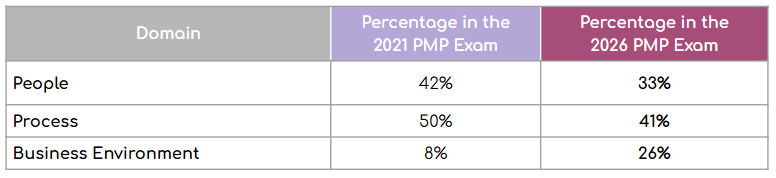
The most noticeable change is the sharp increase in the Business Environment domain, which jumps from just 8% to 26% of the exam. This reflects a growing expectation that project managers understand strategic alignment, governance, value delivery systems, sustainability, compliance, and organizational context, not just task execution.
At the same time, the People and Process domains have slightly decreased in weight. This does not mean leadership or process knowledge is less important. Instead, it means that project managers are now expected to operate beyond team coordination and workflow control. They must think at a strategic and enterprise level.
In practical terms, candidates can expect significantly more scenario-based questions involving business strategy, governance decisions, stakeholder impact, regulatory considerations, and value optimization.
Another major change in the 2026 PMP exam is the distribution of delivery approaches. In the 2021 PMP exam, agile/hybrid and predictive approaches were evenly split at 50% each. In the 2026 update, that balance shifts:

This change confirms that agile and hybrid environments are now the dominant reality in project management practice. However, this does not mean predictive methodologies are disappearing. Instead, PMI is reinforcing the need for contextual decision-making. Candidates must understand when to use agile, when predictive is appropriate, and how to tailor hybrid solutions based on risk, stakeholder expectations, regulatory constraints, and organizational maturity.
The 2026 PMP exam increasingly tests judgment rather than methodology memorization. You are expected to evaluate real-world constraints and justify the best approach.
New and Enhanced Question Types
One of the most noticeable updates in the 2026 PMP exam is the expansion of question formats. The traditional multiple-choice and multiple-selection formats remain, but the exam now includes more interactive and applied question types:
- Case or Scenario
- Graphic-Based Questions
- Enhanced Matching
- Matching
- Point and Click
- Pull-down List
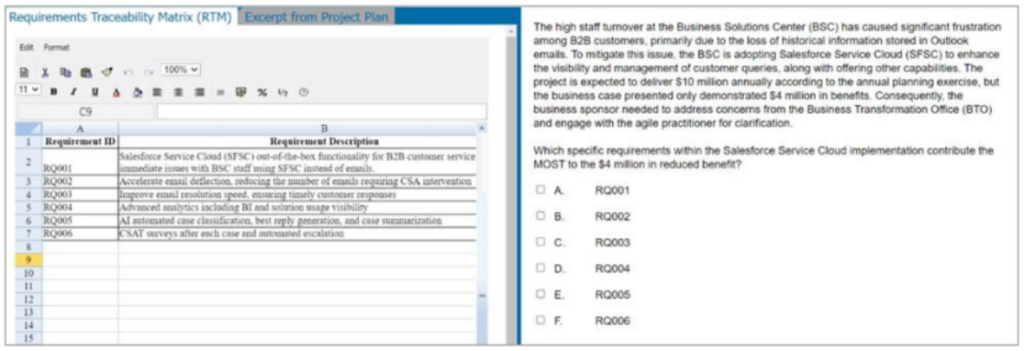
Candidates will encounter case or scenario-based questions that require analyzing realistic project situations before selecting the best course of action. Graphic-based questions are also introduced, requiring interpretation of visual information such as charts or diagrams.
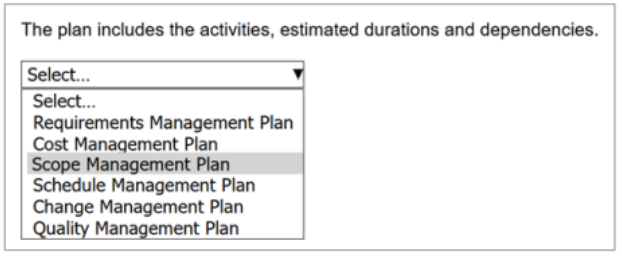
Pull-down list questions and enhanced matching formats add another layer of cognitive engagement. These new formats emphasize critical thinking. Instead of identifying definitions, candidates must evaluate stakeholder dynamics, risk trade-offs, governance considerations, and strategic impacts before making a decision. The exam is becoming less about memorization and more about professional reasoning.
If you are preparing for the Project Management Professional (PMP) certification in 2026, your study strategy should reflect these changes. Focus on understanding context, practicing scenario-based questions, and developing structured decision-making skills. Strengthen your knowledge of AI integration, sustainability considerations, governance frameworks, and hybrid methodologies. Adapting your preparation now will position you for success when the updated exam launches in July 2026.